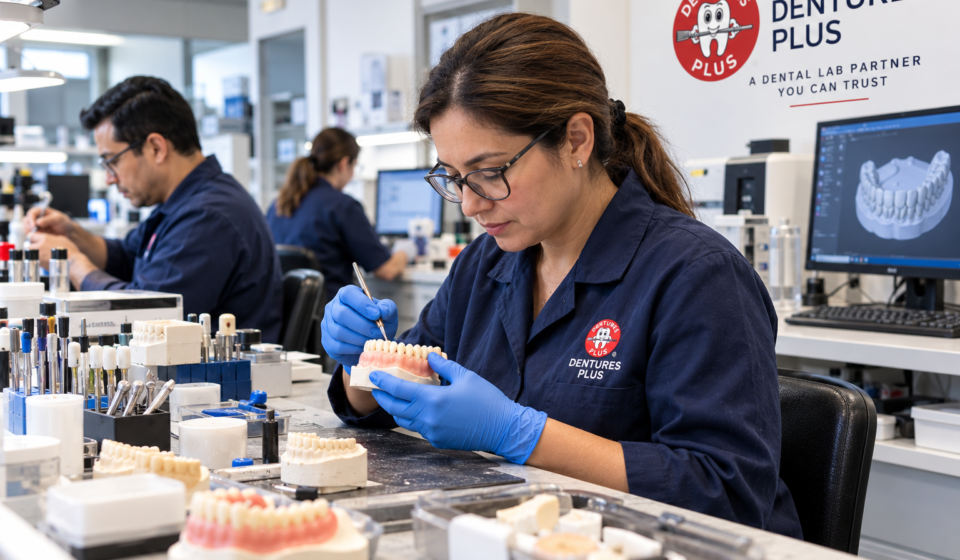

Choosing the right dental laboratory is an important decision for any dental practice. The laboratory you work with can become an important part of your day-to-day case workflow, from receiving prescriptions and digital scans to producing restorations and communicating about individual cases.
For dentists in San Jose, finding a dental lab that understands clinical requirements, communicates clearly, and supports both digital and traditional workflows can make case coordination easier.
But what should a dental practice actually look for when choosing a laboratory partner?
1. Experience With Different Types of Dental Cases
A dental laboratory should have experience handling the types of cases your practice regularly sends out.
Depending on the needs of the practice, this may include:
- Full and partial dentures
- Crowns and bridges
- Implant restorations
- Veneers and esthetic restorations
- Dental appliances and night guards
- Full-mouth reconstruction cases
- Digitally designed and 3D-printed restorations
A laboratory with experience across multiple restoration categories can be useful when a practice has different types of cases rather than working with a separate laboratory for every service.
2. Clear Communication With the Dental Practice
Good communication is one of the most important parts of a successful dental laboratory relationship.
A case may include specific instructions regarding shade, design, occlusion, materials, implant information, photographs, or other requirements. When those details are clearly communicated between the dentist and laboratory, the team has better information to work from.
A good lab partner should also have a process for communicating when clarification is needed rather than making assumptions about an unclear case.
For dental practices, responsive communication can be just as important as the laboratory’s technical capabilities.
3. Digital Dental Laboratory Capabilities
Digital dentistry has changed how many dental practices submit cases to laboratories.
Instead of relying only on traditional impressions, dentists may send intraoral scans and digital files such as STL files to the laboratory.
A modern dental laboratory in San Jose, CA should be able to work within digital case workflows while still understanding traditional laboratory processes.
Digital capabilities may include:
- Intraoral scan workflows
- STL file processing
- Digital case review
- CAD-based restoration design
- Digital denture workflows
- 3D printing
- Digital communication between the practice and laboratory
However, technology alone does not determine the quality of a laboratory. Digital tools still need to be combined with experienced laboratory professionals and appropriate quality-control processes.
4. Support for Traditional and Digital Cases
Not every dental case follows the same workflow.
Some practices may primarily use digital impressions and intraoral scanning, while others may continue to send traditional impressions, models, or physical case materials.
For this reason, dentists may benefit from working with a laboratory that can accommodate both types of workflows.
The goal is not simply to find the most technologically advanced lab. It is to find a laboratory that fits the way your practice actually works.
5. Attention to Fit, Function, and Esthetics
Dental restorations need to be considered from more than one perspective.
Depending on the case, dentists may need to consider:
- Functional requirements
- Occlusion
- Restoration design
- Shade and esthetics
- Material selection
- Patient-specific information
- Finishing and polishing
- Final quality control
The laboratory should have a process for reviewing these details throughout the case rather than treating fabrication as a single isolated step.
For esthetic restorations in particular, accurate case information and communication between the dentist and laboratory are important parts of the workflow.
6. A Laboratory That Understands Your Practice Workflow
Every dental practice operates differently.
Some practices may send a high volume of restorative cases. Others may have a greater need for dentures, implant restorations, crowns and bridges, or digital workflows.
Before choosing a dental lab for dentists in San Jose, consider whether the laboratory can work comfortably with your practice’s:
- Case submission process
- Digital scanning workflow
- Communication preferences
- Restoration requirements
- Case volume
- Scheduling and delivery expectations
A good laboratory relationship should fit into the practice workflow rather than create unnecessary complexity.
7. Reliable Case Review and Quality Control
Quality control is an important part of dental laboratory work.
Before a restoration leaves the laboratory, the case may need to be reviewed for relevant details such as design, finishing, appearance, and other case-specific requirements.
A structured quality-control process helps the laboratory identify issues before the case reaches the dental practice.
Dentists should therefore ask potential laboratory partners how they review cases and what quality-control steps are included in their workflow.
8. Local Support Can Make Communication Easier
For dental practices located in San Jose and surrounding areas, working with a local laboratory can provide a practical advantage.
A local dental laboratory near San Jose may be familiar with the needs of dental practices in the area and can provide a more direct professional relationship.
Local does not automatically mean better, but proximity combined with strong communication, appropriate technology, and experienced laboratory support can make a laboratory relationship more convenient for a dental practice.
9. Look Beyond Price
Cost is naturally one consideration when choosing a dental laboratory. However, dentists should evaluate the overall value of the laboratory relationship rather than comparing prices alone.
Consider factors such as:
- Quality and consistency
- Communication
- Case support
- Digital capabilities
- Range of services
- Laboratory experience
- Quality-control processes
- Ability to handle your practice’s workflow
A laboratory that communicates clearly and understands your case requirements can provide value beyond the laboratory fee itself.
10. Dentures Plus: Supporting Dental Professionals in San Jose
For dental practices looking for a dental lab in San Jose, CA, Dentures Plus provides laboratory services for dental professionals and dental clinics.
The laboratory supports a range of services, including dentures and partials, crowns and bridges, implant restorations, veneers, dental appliances, and digital dental workflows.
Dentures Plus also works with digital case submissions, including intraoral scan and STL workflows, while continuing to support traditional laboratory processes.
The focus is on providing dentists and dental clinics with dependable laboratory support, clear communication, and experienced dental laboratory services.
Questions Dentists Should Ask Before Choosing a Dental Lab
Before starting a relationship with a new laboratory, dentists may want to ask:
- What types of cases does your laboratory specialize in?
- Do you accept digital scans and STL files?
- Can you handle both digital and traditional cases?
- How does your team communicate when case information is unclear?
- What quality-control process do you follow?
- What restoration services do you provide?
- How do you handle complex or multi-stage cases?
- What is your process for case delivery and follow-up?
- Does your workflow fit the way our dental practice submits cases?
- Who should our team contact when we need to discuss a case?
These questions can help a dental practice understand whether a laboratory is a good long-term fit.
Final Thoughts
Choosing a dental lab in San Jose is about more than finding a laboratory that can manufacture restorations. Dentists should also consider communication, case support, digital capabilities, quality control, service range, and how well the laboratory fits into the practice’s workflow.
The right laboratory partner should make communication and case coordination easier while providing the technical and professional support needed for different types of dental cases.
For dental professionals in San Jose, evaluating these factors can help build a more reliable and productive relationship with their dental laboratory partner.