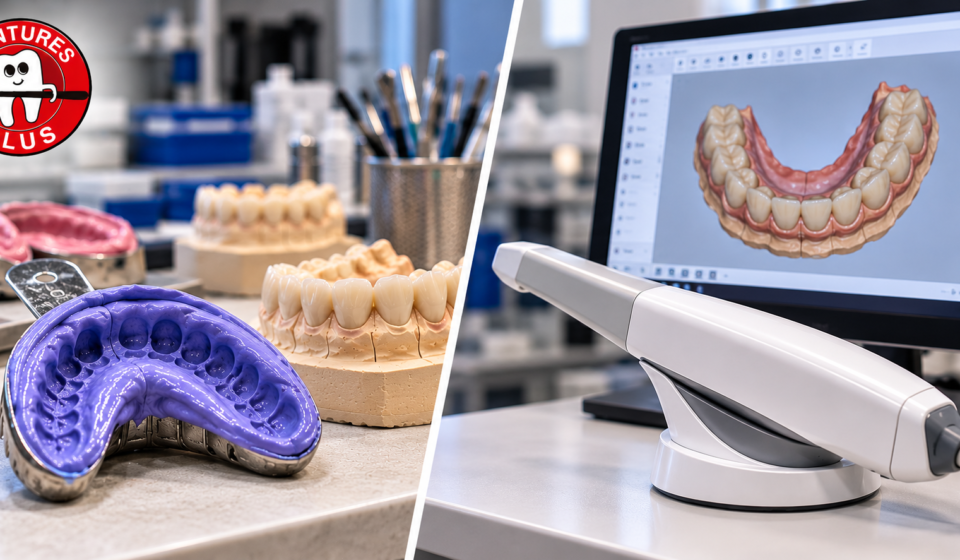

Dental practices use different methods to capture and submit patient case information to a dental laboratory. Traditional impressions remain part of many dental workflows, while digital scanning allows practices to transfer intraoral scan files electronically.
For dentists working with a dental lab in San Jose, CA, understanding these two approaches can help with case preparation, communication, and workflow coordination.
Neither method is automatically the right choice for every situation. The appropriate approach depends on the clinical case, the dentist’s workflow, the available equipment, and the laboratory’s requirements.
In this guide, we explain the key differences between traditional impressions and digital scans and what dentists should consider when working with their dental laboratory.
1. What Are Traditional Dental Impressions?
Traditional dental impressions use impression material placed in a tray to capture the shape and details of the teeth and surrounding oral structures.
After the impression is taken, it can be sent to the dental laboratory for the next steps in the restoration or appliance workflow.
Depending on the case, the laboratory may use the impression to produce a physical model and carry out the required laboratory work.
What dentists should consider
When preparing a traditional impression for laboratory submission, dentists should follow the requirements for the specific case.
Important considerations may include:
- Selecting an appropriate impression tray and material.
- Capturing the necessary anatomical details.
- Checking the impression for visible defects or distortions.
- Including the required bite registration and opposing arch information, where applicable.
- Providing a completed laboratory prescription.
- Following the laboratory’s packaging and shipping instructions.
The exact requirements depend on the restoration or appliance being fabricated. Dentists should confirm the appropriate submission process with their laboratory.
2. What Are Digital Dental Scans?
Digital dental scans use an intraoral scanner to capture information about the teeth and oral structures. The scanner generates digital data that can be transferred to a dental laboratory using a compatible workflow.
Digital submissions may include scan files and additional case information required for the requested restoration.
Dentures Plus accepts major intraoral scans and STL files, according to its published company information. Dentists should confirm the specific file and case requirements before submitting a new case. Dentures Plus
What dentists should consider
Before submitting a digital case, check the following:
- The required scan data has been captured.
- The relevant arches and bite information are included, as required.
- The files can be opened and reviewed.
- The restoration specifications are clearly documented.
- The laboratory prescription matches the submitted case.
- Any special instructions are communicated to the laboratory.
A digital workflow can simplify electronic file transfer, but it still depends on complete and usable case information.
3. Traditional Impressions vs. Digital Scans: Key Differences
Both methods can form part of a dental laboratory workflow. However, they differ in how case information is captured, transferred, and handled.
| Consideration | Traditional Impressions | Digital Scans |
|---|---|---|
| Information capture | Uses physical impression material | Uses an intraoral scanner |
| Submission method | Physical impression is sent to the lab | Digital files are transferred electronically |
| Physical handling | Requires handling and transport of the impression | Requires compatible digital files and transfer |
| Case review | Physical impression and related records are reviewed | Digital scan data and related records are reviewed |
| Potential workflow challenges | Impression defects, distortion, or transport issues | Incomplete scans, missing data, or file compatibility issues |
| Preparation requirements | Proper impression technique and packaging | Complete scan data and correct file submission |
Important: The best approach depends on the individual case and the requirements of the dentist and laboratory. Neither method guarantees a better restoration or a faster turnaround time in every situation.
4. How the Submission Method Can Affect Laboratory Workflow
The method used to submit a case is only one part of the overall workflow. The completeness of the information and the requirements of the restoration are also important.
With traditional impressions
The laboratory needs to receive the physical impression and any additional records required for the case. Defects, missing components, or unclear instructions may require further communication before work can proceed.
With digital scans
Digital submissions can allow the laboratory to receive case files electronically. However, incomplete scan data, missing bite information, incompatible files, or unclear restoration specifications may still require clarification.
In both workflows, dentists can support effective coordination by submitting complete case information and responding to laboratory questions when necessary.
5. Which Method Is Better for Crowns, Bridges, and Other Restorations?
The appropriate submission method depends on the restoration, the clinical circumstances, and the capabilities of the dental practice and laboratory.
For crowns and bridges, dentists should confirm which submission methods the laboratory accepts and what records are required for the specific restoration.
For implant restorations, additional information about the implant system and relevant components may be necessary.
For dentures and other dental appliances, the required records and workflow may differ depending on the appliance and case.
Before starting a case, dentists should discuss any special requirements with their laboratory rather than assuming that every restoration follows the same process.
6. Questions to Ask Your Dental Lab Before Submitting a Case
Whether your practice uses physical impressions or digital scans, clear communication with the laboratory helps establish expectations.
Consider asking these questions:
Which submission methods do you accept?
Confirm whether the laboratory accepts traditional impressions, digital scans, or both for the service you need.
What information must accompany the case?
Ask about prescriptions, scan files, bite records, shade information, and other requirements relevant to the restoration.
Which digital file formats are supported?
Confirm compatibility before sending files from a new scanner or software system.
How should incomplete or unclear submissions be handled?
Understand how the laboratory will communicate questions or request additional information.
What is the expected turnaround time?
Ask about the estimated schedule for the specific restoration and when the turnaround period begins.
Discussing these points in advance can help dental practices establish a more consistent submission process.
7. Working With a Dental Lab in San Jose, CA
For dental practices looking for a dental laboratory in San Jose, CA, it is useful to evaluate more than the available technology.
Consider the laboratory’s services, accepted submission methods, communication practices, and requirements for individual cases.
Dentures Plus is a dental laboratory based in San Jose, California, providing services that include dentures, crowns and bridges, implant restorations, and other dental solutions. The company also states that it accepts major intraoral scans and STL files. Dentures Plus
Dental practices considering Dentures Plus can contact the team to discuss their laboratory needs, clarify submission requirements, and determine which workflow is appropriate for their cases.
The goal is to establish a practical working process that supports clear communication between the dental practice and laboratory.
Frequently Asked Questions
Are digital scans better than traditional dental impressions?
Neither method is universally better for every case. The appropriate method depends on the restoration, clinical requirements, available technology, and laboratory workflow.
Can dental laboratories accept both traditional impressions and digital scans?
Some laboratories support both methods, but acceptance can vary by laboratory and restoration type. Dentists should confirm the available options before submitting a case.
Do digital scans guarantee faster dental lab turnaround times?
No. Digital scans may simplify electronic submission, but turnaround time also depends on case complexity, the completeness of the information, laboratory processes, and scheduling.
What should dentists include when submitting a digital scan?
Depending on the case, required information may include the appropriate scan files, bite data, restoration specifications, shade information, and a completed laboratory prescription. The dentist should follow the laboratory’s submission requirements.
Where can dentists find a dental lab in San Jose, CA?
Dental practices can evaluate laboratories based on their services, accepted submission methods, communication, and case requirements. Dentists can contact Dentures Plus in San Jose to discuss their laboratory needs.
Conclusion
Traditional impressions and digital scans are two approaches to capturing and transferring dental case information. Each has its own handling requirements, and the appropriate method depends on the case and the laboratory workflow.
For dental practices, complete case records, compatible submissions, and clear communication remain important regardless of the method used.
When choosing a dental laboratory in San Jose, CA, dentists should confirm which submission methods are supported and understand the requirements for each restoration.
Dentures Plus works with dental professionals from its San Jose location. Contact the team to discuss your case-submission requirements and laboratory services.