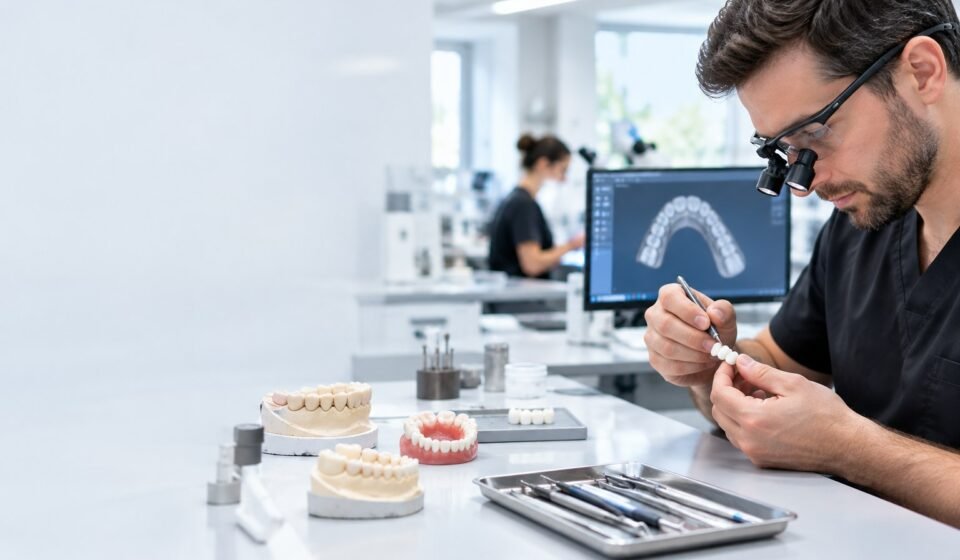

Choosing a dental laboratory is an important decision for any dental practice. The laboratory you work with becomes part of your day-to-day workflow, especially when your practice regularly handles dentures, crowns, bridges, implant restorations, veneers, and other dental appliances.
A good dental lab should be more than a place where cases are fabricated. It should be a professional partner that understands your requirements, communicates clearly, pays attention to detail, and consistently delivers work according to the case prescription.
For dentists, the question isn’t simply, “Which dental lab is affordable?” It is also, “Which lab can I trust with my cases?”
Why Choosing the Right Dental Lab Matters
Dentists and dental laboratories have different responsibilities, but both are working toward the same treatment plan. The dental practice provides the clinical information, impressions or digital scans, photographs, shade details, and prescription. The laboratory uses that information to design and fabricate the restoration.
When the relationship between the dentist and laboratory works well, communication becomes easier and case requirements are clearer. On the other hand, poor communication or inconsistent laboratory work can create unnecessary back-and-forth, revisions, and delays.
That is why choosing a reliable dental lab can become an important part of managing a smooth restorative workflow.
1. Look for Consistent Quality
Quality should be one of the first things a dentist evaluates when considering a dental laboratory. A laboratory may have modern equipment and technology, but the quality of the finished restoration still depends on how carefully each case is handled.
Dentists should look for a lab that pays attention to:
- Restoration design
- Fit and adaptation
- Occlusion
- Shade and esthetics
- Material selection
- Finishing and polishing
- Case-specific instructions
Consistency is particularly important. A dental practice should be able to expect the same level of attention from one case to the next.
2. Communication Is Just as Important as Craftsmanship
Even a highly experienced dental lab will sometimes need clarification from the dentist. A prescription may require additional information, a shade may need confirmation, a digital file may need to be reviewed, or a particular case may have requirements that are not obvious from the initial submission.
Before choosing a dental laboratory, dentists should consider:
- Can I easily communicate with the lab?
- Will someone respond when I have a case question?
- Does the laboratory understand my instructions?
- Are potential issues communicated before they become bigger problems?
A responsive lab can make the overall case workflow much easier for a dental practice.
3. Understand the Laboratory’s Digital Workflow
Digital dentistry has changed the way dental practices and laboratories work together. Instead of relying exclusively on traditional impressions, many practices now use intraoral scanners and digital case submissions.
Digital files can include scans, photographs, prescriptions, and other case information that can be transferred to the laboratory. A modern dental laboratory may work with technologies such as:
- Intraoral scan files
- CAD/CAM workflows
- Digital case design
- 3D printing
- Digital denture workflows
- STL files and other digital formats
However, technology should not be viewed as a replacement for experience. The best workflow combines modern technology with skilled dental laboratory professionals.
4. Consider the Range of Services
A dental practice may need different types of laboratory work throughout the year. One case might require a crown, while another may involve a partial denture, implant restoration, veneer, or dental appliance.
Depending on the needs of the practice, dentists may want to consider whether a laboratory provides:
- Complete and partial dentures
- Crowns and bridges
- Implant restorations
- Veneers and esthetic restorations
- Dental appliances
- Night guards
- Digital dentistry solutions
- 3D-printed dental restorations
The right service mix depends on the individual practice, but having access to multiple laboratory solutions can simplify the dentist-lab relationship.
5. Experience Still Matters
Dental technology continues to evolve, but experience remains important. Experienced laboratory professionals understand that every case has its own requirements. They know how to work with different materials, restoration types, digital workflows, and dentist prescriptions.
When evaluating a dental lab, dentists can ask:
- How long has the laboratory been serving dental professionals?
- What types of restorations does it regularly produce?
- Does the team have experience with the cases my practice handles?
- Does the lab continue to adopt useful dental technologies?
A combination of experience, craftsmanship, and technology can provide a strong foundation for a long-term laboratory partnership.
6. Reliability Should Be Part of the Decision
A dental practice depends on multiple people and processes to keep cases moving. The laboratory is one part of that process. Dentists should therefore consider how reliable a prospective lab is when it comes to case communication, production, and delivery.
Reliability does not mean that every case will be identical or that unexpected situations will never occur. Instead, it means the laboratory has a professional process for handling cases and communicating when something needs attention.
Clear expectations between the dentist and lab can help avoid unnecessary surprises.
7. Ask How the Lab Handles Case-Specific Requirements
Every restoration is not simply a standard order. Some cases have very specific requirements regarding esthetics, materials, design, or other details. A good dental lab should have a process for understanding those requirements before beginning fabrication.
When speaking with a potential lab partner, dentists can ask:
- How do you handle special case instructions?
- How are questions communicated to the dental practice?
- What happens if additional information is required?
- How are revisions or changes handled?
These questions can tell you a lot about how the laboratory works with its dental clients.
8. Don’t Choose a Lab Based on Price Alone
Cost naturally matters to every dental practice. However, choosing a laboratory based only on the lowest price may not always be the best long-term decision.
The overall value of a dental lab relationship can include:
- Quality of craftsmanship
- Communication
- Reliability
- Technology
- Range of services
- Professional support
- Experience
A laboratory that consistently provides dependable work and communication may offer greater value to a practice than a lab that simply has a lower laboratory fee. The goal should be to find the right balance between quality, service, reliability, and cost.
9. Why a Local Dental Lab Can Be Worth Considering
For dentists in San Jose and surrounding areas, working with a local dental laboratory can provide an opportunity to build a closer professional relationship.
Local does not automatically mean better, of course. The laboratory still needs to meet the practice’s expectations for quality and service. But having a nearby laboratory partner can make communication and professional collaboration more convenient.
For dentists searching for a dental lab in San Jose, it can be useful to consider both the laboratory’s capabilities and the relationship they can build with the dental team.
Questions Dentists Can Ask Before Choosing a Dental Lab
- What types of dental restorations do you specialize in?
- Do you support digital impressions and intraoral scans?
- How do you communicate about case questions?
- What technology and fabrication methods do you use?
- How do you handle special case instructions?
- What types of dental practices do you typically work with?
- How do you handle revisions or adjustments?
- Can your laboratory support the types of cases my practice regularly sends?
The answers can help you determine whether the lab is a good fit for your practice.
Why Dentures Plus?
At Dentures Plus, we understand that dentists need a dental laboratory partner they can rely on. Our focus is on serving dentists, dental clinics, and dental professionals with dental laboratory solutions that combine careful craftsmanship, modern technology, and professional support.
Our services include dentures and partials, crowns and bridges, implant restorations, veneers, dental appliances, and digital dentistry solutions.
With decades of experience serving dental professionals, we understand the importance of paying attention to the details of every case and maintaining clear communication throughout the laboratory process.
Our goal is not simply to complete a restoration. It is to build a dependable working relationship with the dental professionals we serve.
Final Thoughts
Choosing a dental laboratory is ultimately about finding the right professional fit for your practice. Quality craftsmanship matters. Technology matters. Experience matters. But so do communication, reliability, and the ability to understand the specific needs of your dental practice.
Before choosing a laboratory, take the time to look beyond pricing and consider the complete partnership.
The right dental lab should make your workflow easier, support your cases professionally, and give your practice confidence in the laboratory partner working behind the scenes.
Looking for a dependable dental lab partner in San Jose? Dentures Plus is here to support dentists and dental clinics with professional dental laboratory services.
FAQs About Choosing a Dental Lab Partner
Find answers to common questions dentists should consider before selecting a dental laboratory.
What should dentists look for in a dental laboratory?
Why is communication important with a dental lab?
Should a dental lab support digital workflows?
Should dentists choose a dental lab based only on price?
What questions should dentists ask before choosing a lab?