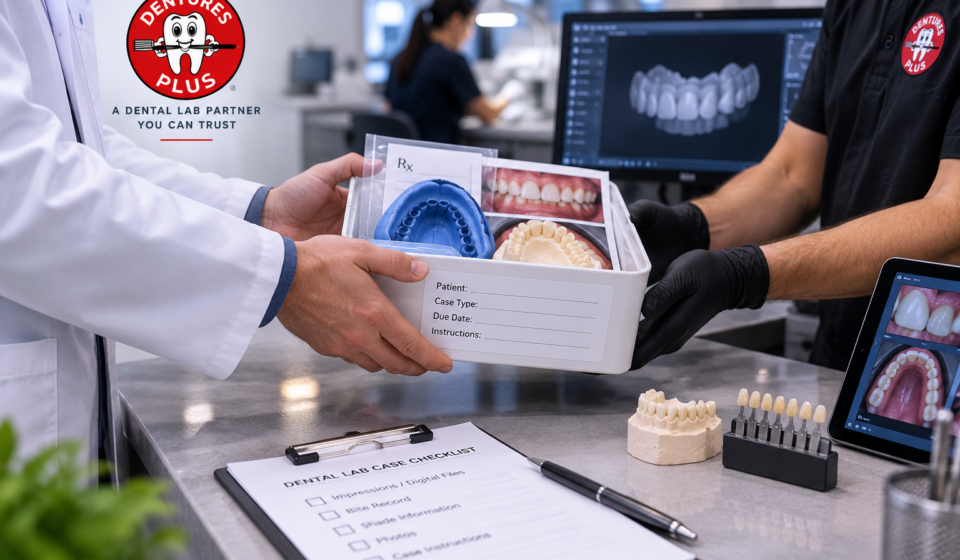

When a dental case is sent to a laboratory, the quality of the final restoration depends on more than the laboratory itself. The information provided with the case is an important part of the process.
Whether a dentist is sending a crown, bridge, denture, partial denture, veneer, implant restoration, or another appliance, clear and complete case information gives the dental laboratory a better understanding of what is required.
For dentists, having a consistent case submission process can also make communication with the lab easier and help avoid unnecessary questions or delays.
Here is what dentists should consider including with every dental laboratory case.
1. Clear Case Instructions
The laboratory should know exactly what restoration or appliance is being requested.
Case instructions may include:
- Type of restoration
- Teeth involved
- Material or restoration requirements
- Design preferences
- Special instructions
- Important functional or esthetic considerations
- Requested completion date, where applicable
A simple but complete prescription gives the laboratory a clear starting point.
If something about the case is particularly important, it is better to state it directly rather than assume the laboratory will know.
2. Accurate Impressions or Digital Scans
The laboratory needs an accurate representation of the patient’s oral structures to produce the requested restoration.
Depending on the dentist’s workflow, this may include traditional impressions or digital files.
Digital dentistry has made case communication considerably more convenient. Dentists can send digital scans and STL files directly to laboratories that support digital workflows.
At Dentures Plus, digital case workflows are part of our laboratory services, and we accept major intraoral scans and STL files.
The key point is simple: the better the information received by the laboratory, the better the laboratory can understand the case.
3. Bite and Occlusal Information
Occlusion is an important consideration in restorative cases.
Depending on the case, the laboratory may need appropriate bite or occlusal records to understand how the upper and lower arches relate to one another.
Incomplete or unclear bite information can make case communication more difficult, particularly when the restoration requires careful attention to function.
Dentists should therefore make sure the laboratory receives the appropriate records for the type of case being submitted.
4. Shade Information for Esthetic Cases
For crowns, veneers and other esthetic restorations, shade information is an important part of the prescription.
Depending on the case, dentists may provide:
- Selected shade
- Shade photographs
- Reference photographs
- Existing restoration information
- Additional esthetic instructions
Photographs can be especially useful when the dentist wants to communicate details that may not be fully represented by a written shade selection alone.
Clear communication about esthetic expectations gives the laboratory useful context when working on the restoration.
5. Clinical Photographs When They Add Value
Photographs aren’t necessary for every case, but they can be valuable for cases where appearance, tooth position, characterization or existing conditions are important.
Useful photographs may provide additional information about:
- Tooth shape
- Shade
- Contours
- Smile characteristics
- Existing restorations
- Specific areas the dentist wants the laboratory to consider
A photograph can sometimes communicate something much faster than a long written explanation.
6. Implant Information for Implant Cases
Implant restorations often require additional case information compared with conventional restorative cases.
Depending on the restoration and workflow, the laboratory may need relevant implant-related specifications and components information along with the dentist’s restoration instructions.
The exact requirements can vary depending on the implant case, restoration design and laboratory workflow.
This is one reason clear communication between the dentist and laboratory is particularly important for implant cases.
7. Patient and Case Identification
Every case should be clearly identified so the laboratory can associate the submitted records with the correct prescription and restoration.
Dentists should follow their normal practice and laboratory procedures for case identification while avoiding unnecessary patient information.
The goal is straightforward: the laboratory should be able to clearly identify which records belong to which case.
8. Mention Anything That Is Different About the Case
Not every case follows the standard workflow.
If there is something unusual or particularly important about a case, tell the laboratory.
For example, the dentist may have a specific esthetic request, an existing restoration that needs to be considered, or a particular design preference.
These details may seem minor, but they can be important when the laboratory is interpreting the prescription.
A Complete Case Submission Helps Both the Dentist and the Lab
A dental laboratory can only work with the information it receives.
When a case arrives with clear instructions, accurate records and the necessary supporting information, the laboratory has a better understanding of the dentist’s expectations from the beginning.
This can make communication more efficient and reduce the need for repeated clarification.
It also creates a more consistent workflow between the dental practice and laboratory.
Digital Dentistry Is Making Case Communication Easier
Digital workflows are changing how dentists and laboratories exchange case information.
Instead of relying entirely on physical impressions and paperwork, dental practices can use digital scans and electronic case files where supported by their laboratory workflow.
For a dental lab, being able to receive and work with digital information can help create a more connected process from the dental practice to laboratory production.
However, technology does not replace communication.
A digital scan still needs to be accompanied by the appropriate case information and instructions.
What Should Dentists Check Before Sending a Case?
Before submitting a case, a quick checklist can help:
Case Submission Checklist
- Is the restoration clearly specified?
- Are the correct teeth identified?
- Are the impressions or digital scans accurate and complete?
- Is the bite information included when required?
- Is the shade clearly communicated?
- Are photographs included when they would help?
- Are implant-related details included for implant cases?
- Are special instructions clearly written?
- Is the case correctly identified?
Taking a few extra moments before submission can make the laboratory workflow much clearer.
Choosing a Dental Lab That Communicates With Your Practice
Case submission is only one part of the dentist-laboratory relationship.
A good laboratory partnership also depends on communication, consistency, technology and professional support.
Dentists should look for a laboratory that understands their workflow, provides clear communication and can support the types of cases their practice regularly handles.
At Dentures Plus, we work with dentists and dental clinics as a full-service dental laboratory. Our services include dentures and partial dentures, crowns and bridges, implant restorations, veneers, dental appliances and other laboratory solutions.
Our digital workflow also supports digital case submissions, including major intraoral scans and STL files.
Final Thoughts
A successful dental laboratory case starts before the laboratory begins working on the restoration.
Clear instructions, accurate records, appropriate photographs, shade information and case-specific details give the laboratory the information it needs to understand the dentist’s expectations.
For dental practices, creating a consistent case submission process can make communication with the laboratory easier and help build a stronger working relationship over time.
The best dental lab partnerships are built on more than the restoration itself — they are built on clear communication from the start.
FAQs About Dental Lab Case Submissions
Find answers to common questions about preparing and sending dental cases to a laboratory.
What information should a dentist send with every case?
Are digital scans accepted by dental laboratories?
When should clinical photographs be included?
Why is shade information important?
What should be checked before sending a dental case?